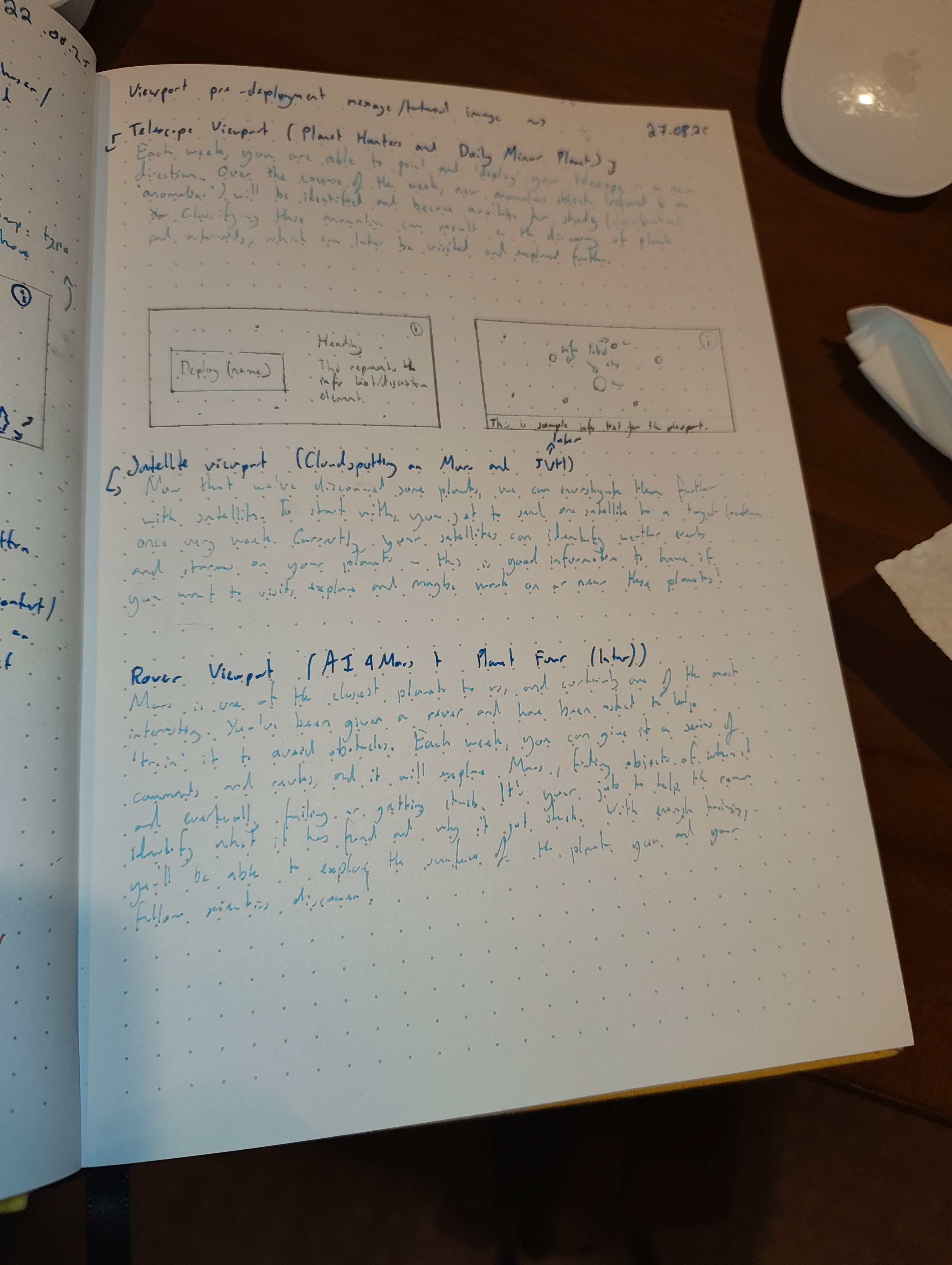
For Telescope :
Each week, you are able to point and ‘deploy’ your telescope in a certain direction. Over the course of the week, new anomalous objects (referred to as “anomalies”) will be identified by your telescope and become available for study. Classifying these anomalies can result in the discovery of planets and asteroids, which can later be visited and explored further.
For Satellite viewport:
Now that we’ve discovered some planets, we can investigate them further with satellites. To start with, you get to send a satellite to a target location once every week. Currently, your satellites can identify weather events and storms on your planets - this is good information to have if you want to explore and maybe work on, or near, these planets!
For Automatons viewport:
Mars is one of the closest planets to us, and certainly one of the most interesting. You’ve been given a rover and have been asked to help ‘train’ it to avoid obstacles. Each week, you give it a series of commands and routes; and it will explore Mars, finding objects of interest and eventually getting stuck. It’s your job to help the rover identify what it has found and why it got stuck. With enough training, you’ll be able to explore the surface of the planets you and other scientists discover.