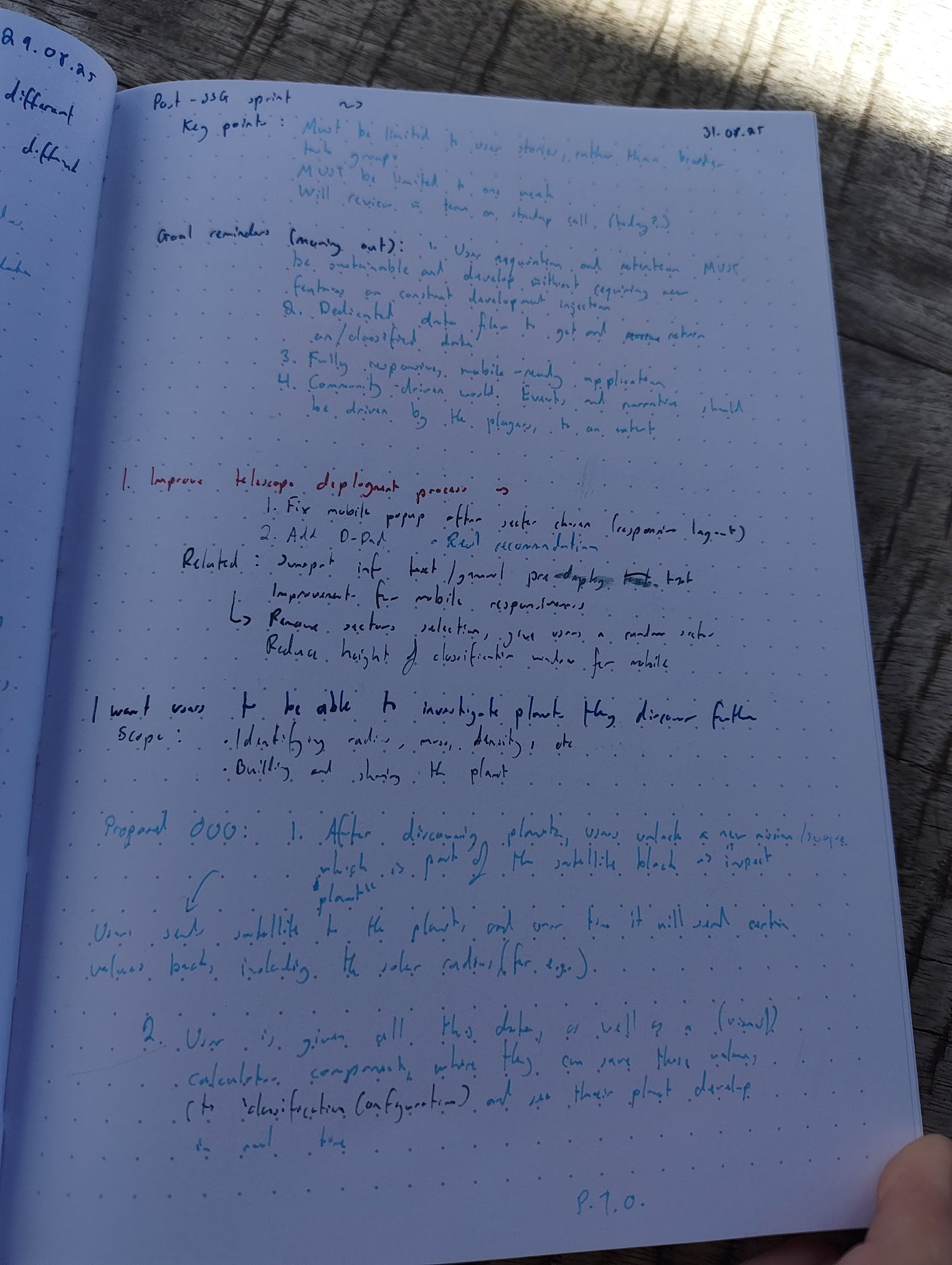
Initial thoughts: I’m going to immediately focus on components like the sidebar and other UI improvements and concepts that have been brought up in the 30 August 2025 meeting as that’s relatively objective feedback…
Story: I want the deployment process for all viewports to be 100% mobile responsive, have clear text & labelling, and remove features that cause decision ambiguity
Note: I might merge the branches after pushing these updates out.
Ticket for this story: SSG-286-1
D-Pad for Telescope deployment page: SSF-19. Turns out we did already have this functionality, but it wasn’t really clear. So hopefully it is now.- Reduce height of classification window
Remove sector names/labels from viewportsFix popup responsiveness for post-deployment information/dialogue (mainly on the Telescope deployment scene)Probably more dialogue for the Telescope deploy scene would be good.Perhaps we bring the “tuning” ability back…
I’ll suggest that the Sidebar is part of this story.
Task: Assign random sector image when user classifies a planet candidate
For PLanetHunters
https://github.com/Signal-K/client/pull/206
Story: Users are able to “continue studying” planets
Ticket for this story: SSG-286-2
- In-Progress section - new sidebar
Follow-up: how do we show this info in the viewports?
We’ll need some info text in the viewport showing available missions
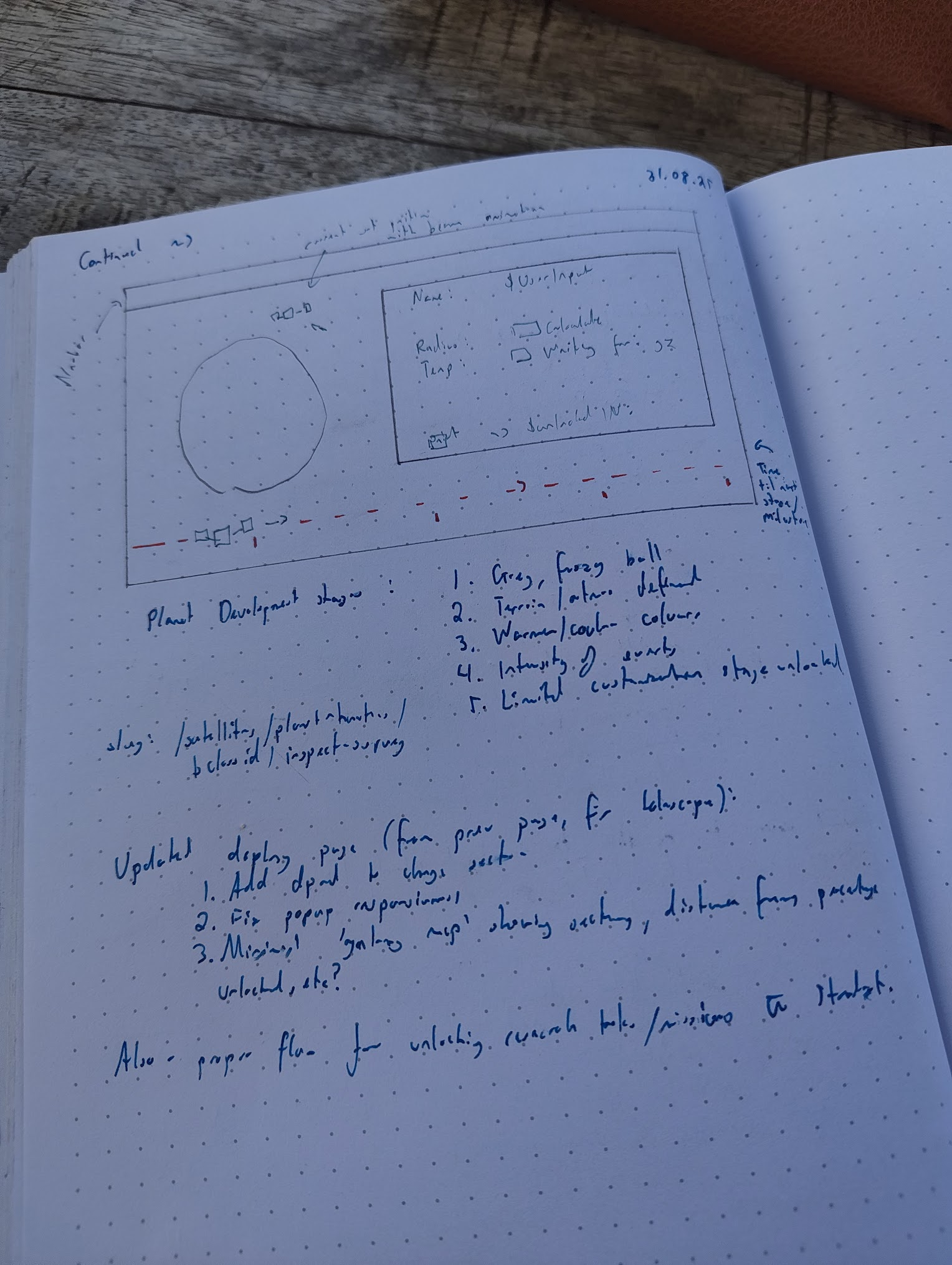
2. New satellite mission/selection option (for deployment): The satellite will be able to be sent to a planet the user has discovered, either to find weather anomalies or to further inspect it. Over the course of the week, new stats will be unlocked. I’m going to draw a slightly expanded design for this later today. At the end of the exploration period, users will have all the base stats A method in the python script to extract solar stats and perform calculations from the TIC graphs, and upload them to Supabase
There is a question about limiting missions - see 2 September 2025
We’ll then allow users to select bonus missions/data in the Research area (e.g. expanding the abilities of their automatons), e.g. spectroscopy data. We could create a sandbox view for them to do whatever they want with this data, eventually?
Perhaps, going along with the Sidebar component, we have an area that shows missions/anomalies in progress. This way, we can see the classifications the user has made.
So the first thing I’ll need to do is to set up an inventory page that shows the user’s classifications. This way, we can show the user “next steps” for each anomaly/classification they’ve made. It also allows me to determine how best to structure the viewports, because viewports may need to show anomalies that are ready to have their initial classification done, and anomalies that need to be inspected further. See SSG-286-3 for more info.
Finally, users will need to be able to see classifications awaiting voting. Opening classifications in viewports as a popup/modal is, I think, the best option.
Inspect button
Users can select the mode of deployment for their satellite - automaton field inlinked_anomaliesgoes toSatellite-PlanetInspectTime remaining for each data point - 10 minutes apartNew page that shows a planet with the stats, the user’s classification, and a publish button
I’ll also need to create a configuration for a grey, fuzzy planet. The configuration for the planet should allow for colours to be changed within a range, based on temperature.
This is a good example configuration:
{
  "type": "terrestrial",
  "seed": 9123,
  "radius": 1.2,
  "temperature": 267,
  "biomass": 0.96,
  "mass": 2,
  "terrainRoughness": 0.6,
  "liquidHeight": 0.55,
  "volcanicActivity": 0.2,
  "continentSize": 0.5,
  "continentCount": 5,
  "noiseScale": 1,
  "debugMode": true,
  "visibleTerrains": {
    "ocean": false,
    "beach": false,
    "lowland": false,
    "midland": false,
    "highland": false,
    "mountain": false,
    "snow": false
  },
  "colors": {
    "atmosphere": "#30373a",
    "ocean": "#1E90FF",
    "oceanPattern": "#1E7FFF",
    "beach": "#F0E68C",
    "lowland": "#228B22",
    "midland": "#006400",
    "highland": "#8B4513",
    "mountain": "#A0A0A0",
    "snow": "#FFFFFF"
  }
}
Adding JVH back is also a must, I think.
Satellite deploy page is another task, and helpfully links in with the question about expanding scope/design of viewports in 30 August 2025
Story: Users are able to see a list of their classifications
- In all viewports
In their profileEnsure that they’re able to share all of them
Ticket id for this story: SSG-286-3
See Viewing a user’s classifications & contributions
Now that I’ve got this done, I can get to work identifying the list of inspection missions for each project, and identifying what the identifier for progress/inspect mission number is for each classificationtype value.
Users can see their stardust values in the Sidebar .- Users can see upgrades available (we’ll mark these as coming soon) - on the research page
Story: Finish route pathing for AI4M with roover automatons
I’m not sure if I’m going to get this done in the current sprint, as I don’t think it’s a priority compared to everything else, but I will strive to get the following tasks done:
- Ensure classification flow works, including removing anomalies from index section viewport post-classification
- Automated deleting of routes at the end of the week
- Little bit more documentation/explanations about what to do - I think this is a discussion point for 2 September 2025 as to the absolute bare minimum Ticket id: SSG-286-4
Beyond the essentials, here’s some other things that fit into this story: 4. /1. Rover animation/icon travelling between route milestones/markers 5. Some sort of reward (resource-wise) to go along with the Stardust? Does research require stardust, but then to actually build the new tech, we need a mineral-type resource?
Update - yeah, probably won’t get this done this week. But, I will work on the specific task/tickets for this…
Story: All missions should have a reward with Stardust
Increase visibleness of stardust reward in post-classification scene
Task: Send out updates on Threads, Twitter, Farcaster
I can do Threads now: https://www.threads.com/@droidology/post/DODgIxlEnOM
Twitter is also done - https://twitter.com/TheMrScrooby
Story: Users can see the project cycles they participate in
Basic scope - we have periods where certain goals for projects are highlighted (see: milestones) and users who work on projects that are featured within these goals can earn badges.
We should also have a section that shows achievements the user has, we’ll treat achievements as unlocking progress towards new missions, technology or entities. See Unlocking missions (achievements).
Update 05/09/25 - this is probably the next focus… perhaps the /next/{classificationId} scene should show progress towards achievements/new skills. We should also generate badges for each skill.
Task Group: General notification flow improvement
- Notifications of unclassified discoveries should be per-user, not sent to every subscribed user
- Notifications of unclassified discoveries should only occur once for each entry in
linked_anomaliestable - We need a method for general unlocking over time for each viewport & mission
Unlocking over time
- Planet Hunters:
- DMP:
- Sunspots:
- AI4M - based on routes
Research/Ideation
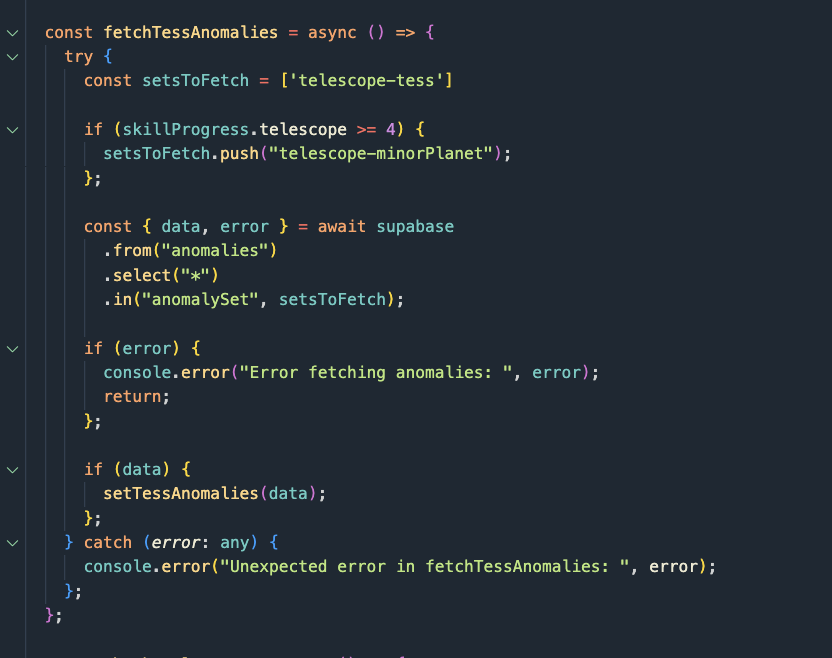
We should probably do something with skillProgress for users; at a minimum, visualising it in the deployment pages:
Post-sprint
- Consensus & dedicated missions/text and incentives (as well as explanations) for consensus/voting is a MUST
- All missions/data should be able to be “inspected” i.e. follow-up. Sandbox mode.
- More visual/interactive deployment modes/scenes Roguelike ideation
- Expanded viewports should have the respective sidebars visible
Voting/consensus: we’ll reward users with stardust for achievements here.